
What is Component-Level PCB Repair?
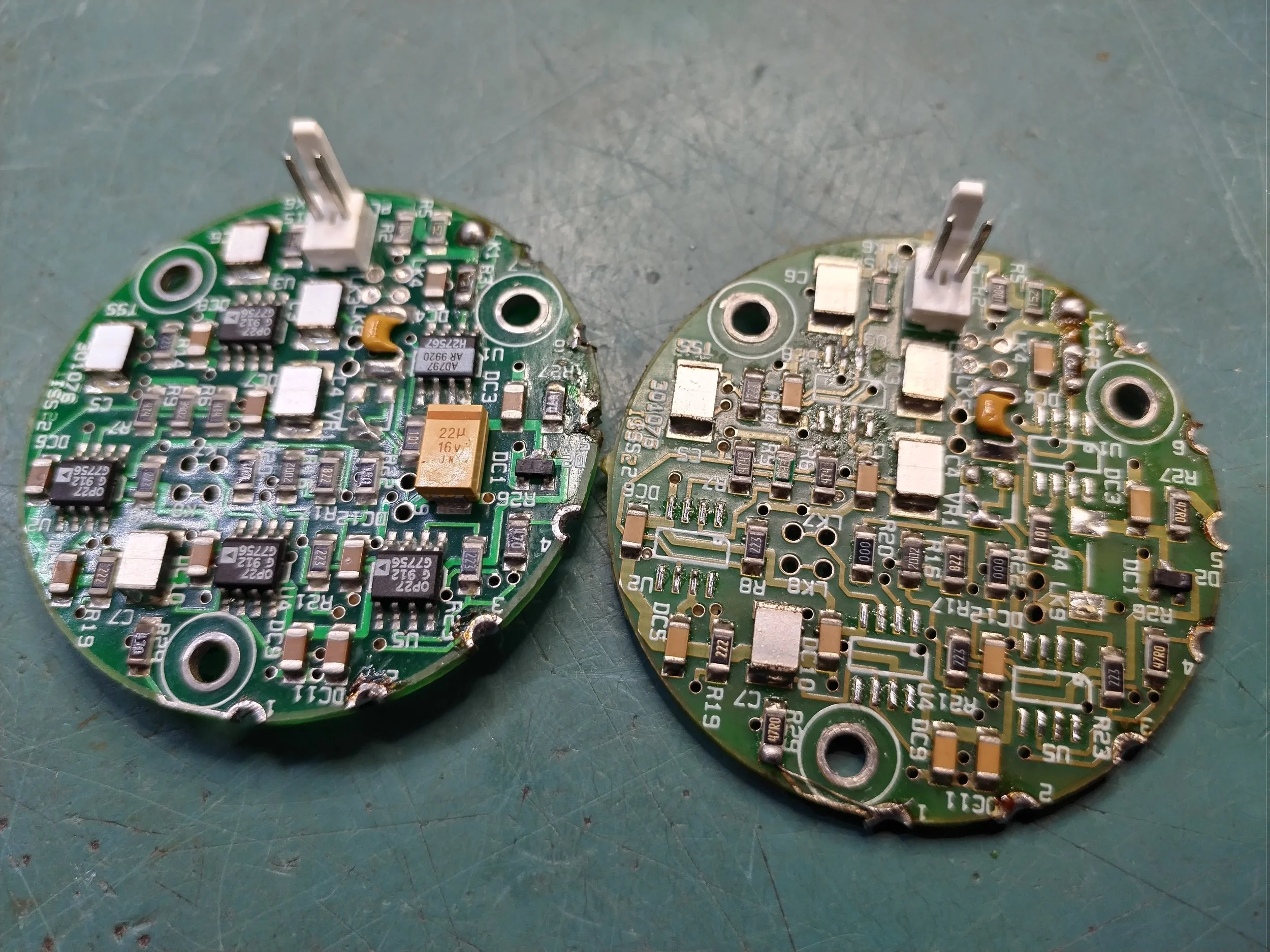
Two PCBs. One fault. Component-level repair finds exactly what failed.
Component level PCB repair is the process of diagnosing and repairing a circuit board down to individual components — resistors, capacitors, MOSFETs, ICs — rather than replacing the board outright.
For industrial operations across the UK, this approach can significantly reduce costs and downtime, particularly where OEM replacements are expensive, long lead time, or no longer available.
At Northern Power Electronics (NPE), based in Newcastle upon Tyne, our engineers carry out component level fault finding and repair on a wide range of industrial electronics — from power supply units and AC/DC drives to servo controllers and marine electronics. Whether you're in manufacturing, offshore, renewable energy, or industrial automation, we provide a cost-effective alternative to straight board replacement, including support for obsolete equipment that manufacturers no longer support.
Board Swap vs Component-Level Repair What's the Difference?
A board swap replaces the whole PCB with a new or second-hand unit. It is fast if the part is available, but it has real limitations:
If the board is obsolete, a replacement may not exist
You lose the original configuration or software stored on the board
You pay for an entire new board when only one component has failed
Lead times for specialist boards can run into weeks or months
Component-level repair works differently. An engineer tests the board, traces the fault to a specific component — a capacitor, transistor, MOSFET, driver IC, or something else — replaces or rebuilds that part, and returns the original board to working condition.
You keep your original board. You keep its configuration. And in most cases, you pay considerably less than you would for a replacement.
How Does Component-Level Repair Actually Work?
The process is methodical, not guesswork. At Northern Power Electronics, it typically works like this:
1. Visual inspection The board is examined for obvious damage — burnt components, cracked solder joints, corrosion, physical impact, or signs of heat stress.
2. In-circuit testing Using ABI BoardMaster technology, our engineers test components and signal paths while the board is intact. This identifies faults that are not visible to the eye — failed capacitors, open circuits, weak solder joints, degraded components.
3. Component identification and sourcing Once the fault is identified, the specific component is sourced. For older or obsolete boards, this may involve finding compatible parts from specialist suppliers.
4. Removal and replacement The faulty component is removed and replaced using precision soldering and rework techniques. On dense or multilayer boards, this requires skill and the right equipment — not just a soldering iron.
5. Functional testing The repaired board is tested to confirm it performs correctly before it is returned to the customer.
What Can Go Wrong at Component Level?
Most PCB failures trace back to a relatively small number of causes:
Capacitor failure — electrolytic capacitors degrade over time, particularly in hot environments. A failed capacitor is one of the most common faults on industrial boards.
Burnt or damaged resistors — often caused by overcurrent or overload conditions.
Failed power components — MOSFETs, IGBTs, and transistors can fail due to voltage spikes, heat, or age.
Dry or cracked solder joints — vibration and thermal cycling cause joints to crack over time, breaking the circuit.
Damaged ICs or driver chips — integrated circuits can fail from static, voltage transients, or prolonged stress.
Corrosion and contamination — moisture, dust, and chemical exposure attack board surfaces and connections.
In many cases, the board looks fine visually. The fault is inside a component or hidden in a solder joint. That is why proper test equipment matters.
Why Does This Matter for Your Business?
If your machine is down, you need it back up as quickly and cost-effectively as possible. Component-level repair is relevant for several reasons:
Cost Repairing a board at component level typically costs significantly less than sourcing a replacement — particularly for specialist or obsolete equipment.
Availability For older machines, replacement boards may simply not be available. Manufacturers discontinue products. Distributors run out of stock. Component-level repair is often the only practical option.
Speed Once a board is assessed and the fault identified, repair is usually faster than waiting for a new board on a long lead time.
Configuration Many industrial boards store machine-specific settings, parameters, or firmware. A board swap can mean losing that data. Repairing the original board preserves everything.
Sustainability Repairing rather than replacing reduces electronic waste. For businesses with environmental targets, this is worth noting.
Frequently Asked Questions
What is component-level PCB repair? Component-level PCB repair means diagnosing a faulton a circuit board down to the individual component that has failed, then replacing or repairing that specific part. It is the opposite of board swapping, where the entire board is replaced.
Is component-level repair better than replacing the board? In many cases, yes — particularly for obsolete equipment, specialist boards, or where the original board holds configuration data. It is also typically less expensive. However, it depends on the fault and the condition of the board.
Can you repair PCBs that are no longer manufactured? Yes. Component-level repair is particularly useful for obsolete boards where no replacement exists. As long as components can be sourced and the board is repairable, we can work on it regardless of age.
How long does PCB repair take? It depends on the complexity of the fault and parts availability. Many boards are assessed and quoted within a few days. Repair times vary, but we work to minimise your downtime.
Do you offer a warranty on repaired PCBs? Yes. NPE provides a warranty on repaired electronics. Ask us for details when you contact us.
What industries do you repair PCBs for? We repair PCBs for manufacturing, marine, offshore, food production, water treatment, printing, packaging, heavy industry, and other industrial sectors across the UK.
Talk to NPE About Your PCB
Northern Power Electronics provides component-level PCB repair from our workshop in Newcastle upon Tyne, for businesses across the UK.
If you have a faulty board — whether it is a power supply, drive, control panel, HMI, or any other industrial PCB — send it to us for assessment. We will examine the board, identify the fault, and advise you on the best next step.
Got a failed unit? Send it to us for assessment before ordering a replacement.
📞 0800 001 6045 | ✉ services@npe-uk.com | 🌐 npe-uk.com
