
UPS Failure from Contamination Emerson Liebert GXT3-6000
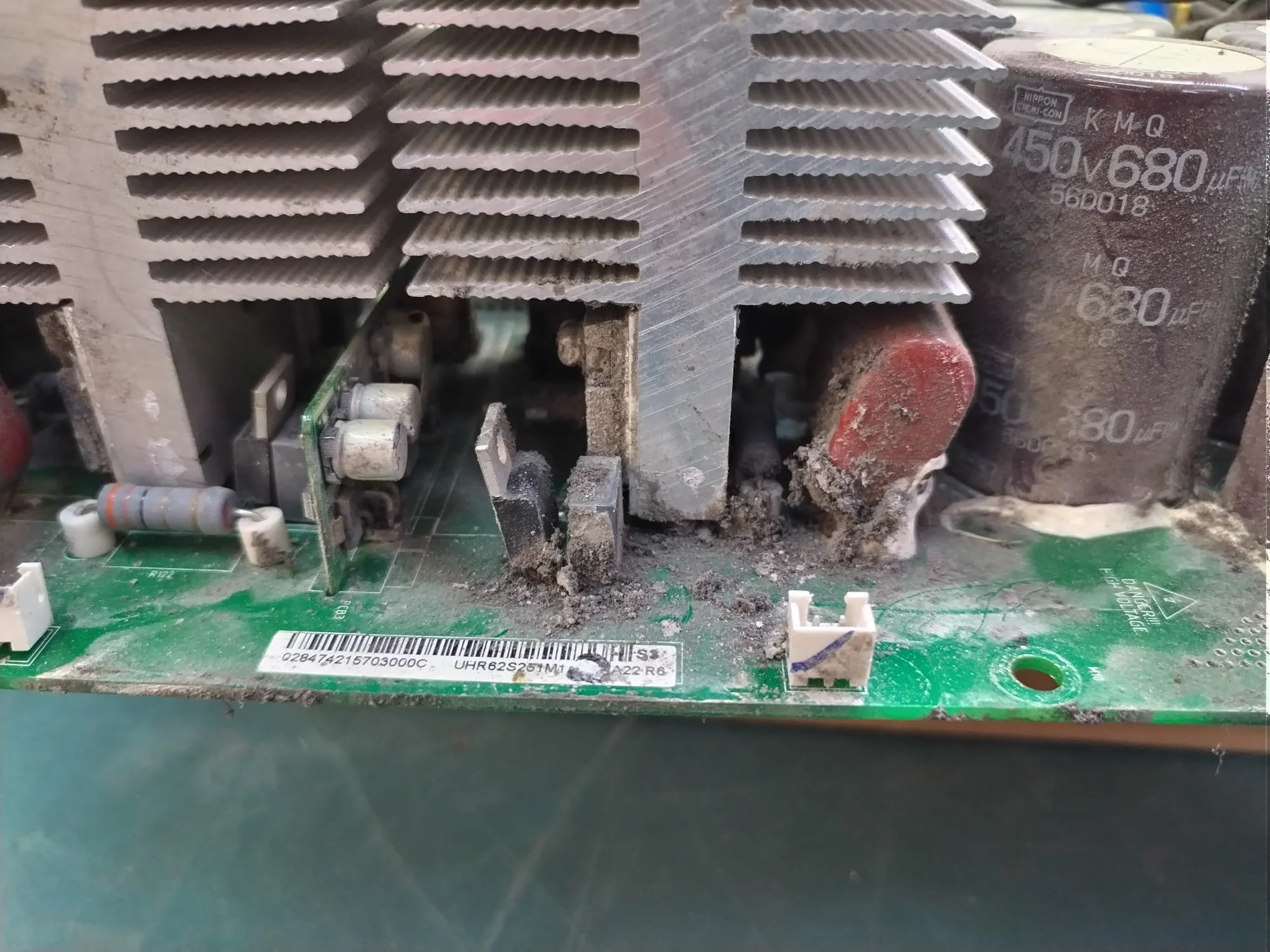
Emerson Liebert GXT3-6000 UPS opened on the NPE workshop bench showing internal contamination across the power section
The Equipment and the Problem
The unit in question is an Emerson Liebert GXT3-6000 — a rack-mounted UPS designed to provide critical power protection for servers, telecoms infrastructure, and industrial control systems. These are workhorses. They run continuously, often in environments that are not as clean as data centres should be.
When this unit arrived at our Newcastle workshop, it was not running. The customer reported intermittent failures followed by a complete shutdown. The fault was not a single component failure — it was the result of years of contamination building up inside the enclosure. This is one of the most common causes of failure we see in aging industrial power electronics.
What We Found Inside
The power board carries four large heatsink arrays, toroidal inductors, and a bank of 450V 680µF electrolytic capacitors — responsible for smoothing DC bus voltage and absorbing load transients. Every one of them was coated in contamination. Capacitor degradation caused by heat and contamination is something we cover in depth in our guide to industrial drive repair.
Between the heatsinks — exactly where airflow is needed most — dust had compacted into solid blocks. Not a light coating. Solid accumulation that was actively blocking thermal dissipation and creating a genuine fire risk.
Why Contamination Causes Failure
Thermal Blocking
Power electronics generate heat as a byproduct of switching. When heatsink fins are blocked with compacted dust, dissipation stops. Components that should operate at 60–70°C begin running at 90°C or above. Every 10°C above rated temperature approximately halves electrolytic capacitor service life and accelerates IGBT degradation.
Moisture Retention
Dust absorbs and retains moisture from the surrounding environment. In any industrial setting where temperature fluctuates, this moisture creates a conductive path between components that should be electrically isolated. The result is tracking — small electrical arcs that gradually damage PCB substrate and component housings. This is a primary failure mode in obsolete industrial equipment that has been running without inspection for years.
Insulation Breakdown
On high-voltage sections of a UPS — such as the 450V DC bus visible in this unit — creepage distances are calculated for clean, dry conditions. Contamination reduces effective creepage distance, leading to partial discharge events and eventually arc-over failure between live conductors. When this happens, the damage extends beyond the contamination itself — components require component-level PCB repair to restore full function.
Warning Signs to Watch For
This level of contamination does not happen overnight. These signs appear months before a unit reaches failure:
- Increased enclosure temperature or frequent thermal shutdown events
- Visible dust accumulation on external vents or fan grilles
- Cooling fan running louder or at higher speed than normal
- Intermittent faults that clear on restart but return over time
- Reduced output performance or voltage regulation issues
- Any smell of burning or ozone near the equipment cabinet
- The unit has not been internally inspected in more than two years
What Preventive Maintenance Actually Involves
Preventive maintenance on industrial electronics is not just compressed air through the vents. A proper inspection covers:
- Cooling system check — fan condition, bearing wear, airflow verification
- Internal cleaning — safe removal of contamination from PCBs, heatsinks and enclosure
- Thermal assessment — temperature measurement of critical components under load
- Capacitor condition — ESR and capacitance testing on DC bus and filter capacitors
- Visual inspection — signs of tracking, corrosion, discolouration, or component stress
- Connection integrity — terminal torque, contact condition and cable insulation
For dusty, humid or offshore environments — annual inspection is the minimum. For critical systems where downtime is not an option, six-monthly checks are worth considering. The cost of a preventive visit is a fraction of what we cover in our guide to how electronic repair reduces operational costs.
The Cost Argument for Preventive Maintenance
A preventive maintenance visit costs a fraction of an emergency repair — and an emergency repair costs a fraction of an unplanned shutdown.
The Emerson Liebert GXT3-6000 is a £3,000–£6,000 unit. A replacement, if available, carries an OEM lead time. For equipment protecting critical servers or industrial control systems, that lead time means downtime you cannot plan around. For discontinued or hard-to-source units, the situation is worse — we regularly repair equipment that manufacturers class as obsolete and unsupportable.
Catching contamination before component failure keeps the unit serviceable. Catching it after means a repair that could have been avoided entirely.
Frequently Asked Questions
How often should a UPS be inspected internally?
Annual inspection minimum for most environments. In dusty, humid or high-particulate locations — foundries, food production, coastal sites — every six months is more appropriate. If the outside is visibly contaminated, the inside will be worse.
Can a heavily contaminated UPS be repaired?
In most cases, yes. The contamination is cleaned and cleared. The question is whether it has caused component-level damage — failed capacitors, damaged IGBTs, tracking on PCBs. If components have failed, we repair at component level. If caught early, cleaning alone may return the unit to full service.
Does NPE repair Emerson Liebert UPS systems?
Yes. We repair Emerson Liebert UPS systems at component level — GXT2, GXT3, GXT4 and NX series. We also repair APC, Eaton, Riello and Chloride systems. OEM support status does not affect repairability.
What does UPS preventive maintenance involve?
Internal inspection, safe cleaning of PCBs and heatsinks, fan condition check, capacitor ESR testing, thermal assessment under load, and connection integrity check. It takes one working day and costs significantly less than an emergency repair.
Do you collect UPS equipment across the UK?
Yes. We collect and return equipment across the UK. Most customers send units to our Newcastle workshop via courier or arrange collection. Turnaround is 1–3 working days from receipt.
Is Your UPS Overdue an Inspection?
If your critical power equipment hasn't been internally inspected in more than a year — or is showing any of the warning signs above — contact NPE for a free assessment. We carry out preventive maintenance and component-level repair on UPS systems, industrial drives, power supplies, and control panels across the UK.
ISO 9001 · ISO 14001 · NOF Member · 1–3 Day Turnaround · 12-Month Warranty
